# Elemental

DeFi Made Simple

Founded during the crypto bear market in **September 2022**, Elemental started on Solana with a modest pool of $1,000 from a handful of early adopters. From these beginnings, Elemental has grown into a leading Solana-based crypto fund, committed to simplifying DeFi investing. With a user-friendly interface and superior risk-adjusted returns, Elemental delivers a transparent, zero-fee investment experience, making DeFi accessible to everyone.

## A Walk Through History

**16 Oct 2025 - Elemental Lend Public Beta**

Elemental opens Elemental Lend to the public, following extensive closed alpha testing. The platform now enters a broader phase of real-world use, demonstrating strong stability and readiness for larger participation. Alongside the beta, Elemental unveils a redesigned stats page, offering transparent performance comparisons against other leading DeFi lending protocols.

**20 Aug 2025 - Elemental Lend Launch**

Elemental introduces Elemental Lend in closed alpha, marking the beginning of its v2 phase. This next chapter focuses on enhancing existing products while expanding the platform with new, yield-driven offerings.

**25 Oct 2024 - SOL Deposits Go Live**

Elemental enables permissionless SOL deposits directly through the website, delivering the same seamless experience as USDC deposits.

**28 Sep 2024 - Open Beta Launch**

Elemental's website transitions from closed alpha to open beta, allowing the public to deposit USDC permissionlessly for the first time. The initial fund capacity was set at 200,000 USDC, with more than half filled within the first 24h.

**22 Jul 2024 - The Deposit Button**

Nearly two years post-launch, Elemental introduces a significant feature — the deposit button. This marks the beginning of the alpha testing of Elemental's first permissionless platform, which features automated deposits, withdrawals, and yield tracking.

**20 Dec 2023 - Entering Liquid Staking**

The Geyser Fund adopts bSOL, a yield-bearing liquid staking token, to offer multi-layered yields. This initiative introduces BLZE tokens, augmenting base yields and promising dynamic, enhanced returns. This launch reinforces Elemental’s dedication to innovative yield strategies and strengthening partnerships within the ecosystem.

**26 Oct 2023 - Inaugural Partnership Fund**

Elemental's first external collaboration comes to fruition with the launch of the Geodium Fund, in partnership with Raydium. This initiative synergizes Raydium’s yield support with Elemental’s enhancements of their liquidity pools, showcasing a commitment to fostering sustainable and beneficial partnerships.

**06 Sep 2023 - Ether Fund Sunset**

Due to diminishing yield opportunities on Solana, Elemental sunsetted the Ether Fund. All investments and their yields were returned to investors. While this decision was pivotal at the time, Elemental remains receptive to relaunching the Ether Fund if market conditions become favorable.

**18 Jul 2023 - Ethereum Expansion**

Striving to further diversify their offerings, Elemental launched its inaugural $ETH fund: Ether. Utilizing wrapped $ETH, the fund offers investors the dynamism of Ethereum's ecosystem, while harnessing the cost-efficiency and high-speed capabilities of Solana.

**19 Mar 2023 - Grizzlython Endeavor**

Elemental made its competitive debut at the seventh Solana hackathon, Grizzlython. Their innovative proposal for a "funds marketplace" aimed to usher in a new era of actively managed funds. Although not victorious, the experience yielded invaluable insights and honed their vision for the future.

**20 Nov 2022 - Fixed-Yield Revolution**

Defying the norm of floating yields, Elemental pioneered fixed-yield returns in the DeFi landscape. Yield rates, stable within each 5-day [Elemental Epoch](https://knowledge.player2.world/businesses/elemental/elemental-epoch), were made possible by the unique Compound Fund, offering a buffer against market volatility.

**02 Oct 2022 - Compound and Insurance Funds Launch**

To cultivate growing yields, Elemental introduced the Compound and Insurance Funds. The former facilitates yield growth over time, while the latter shields users with partial recovery from protocol hacks. In tandem with these advancements, Elemental unveiled its first $USDC fund.

**09 Sep 2022 - Elemental's Genesis**

With a modest starting point of 100 $SOL and a handful of users, Elemental embarked on its journey. Despite initial volatility, the alpha version achieved a robust 18.23% annualized yield, validating the fund's potential.

## Links <a href="#links" id="links"></a>

Official Website: <https://elemental.fund>

Documentation: <https://docs.elemental.fund>

X.com: [https://x.com/elementaldefi](https://twitter.com/elementaldefi)

Telegram: <https://tg.elemental.fund>


# Legal Disclaimer

#### 1. **Acknowledgment of Risk**

By accessing and using this website or any related services provided by Elemental, you acknowledge and agree that all activities conducted through this platform are carried out at your own risk. You further understand that investing in digital assets carries **substantial risk**, including the potential loss of **all deposited funds**. Elemental does not guarantee any returns, and your continued use of this platform confirms your acceptance of these inherent risks.

#### **2. Compliance with Local Laws**

Before engaging with Elemental or participating in any transactions on our platform, you are solely responsible for ensuring compliance with the laws and regulations of your jurisdiction. If local regulations prohibit your use of digital asset services or impose restrictions that conflict with Elemental’s offerings, you must refrain from using our services. By using this platform, you confirm that your activities do not violate any applicable legal or regulatory obligations in your country or region.

#### **3. Geographical Limitations**

Elemental does not make any representations or warranties regarding the legality or suitability of its services outside the jurisdictions in which it operates. We encourage you to obtain independent legal advice if you have questions about the legality of engaging in digital asset transactions within your jurisdiction. Your decision to use Elemental in any location where such usage may be restricted is done at your own risk.

#### **4. No Warranties**

This website and all Elemental services are provided on an “as is” and “as available” basis without any warranty of any kind, whether express or implied. Elemental expressly disclaims all warranties, including those of merchantability, fitness for a particular purpose, and non-infringement. We do not warrant that our services will meet your specific requirements, nor do we guarantee uninterrupted or error-free operation.

#### 5. Liability and Waiver of Claims

By using Elemental’s services, you acknowledge that you have reviewed our [**Risk Disclosure**](/risk-disclosures) and accept the inherent risks of digital asset investments, including the potential for total loss of capital. To the maximum extent permitted by applicable law, you waive any rights to claims or legal action against Elemental, its officers, employees, or affiliates in connection with such losses. Elemental does not offer capital protection, insurance, or recovery mechanisms, and all losses are borne entirely by users.

#### 6. Modifications to Terms

Elemental reserves the right to modify or update this Legal Disclaimer, as well as any other policies, at its sole discretion. Any changes will be effective immediately upon posting to this website. Your continued use of Elemental’s services after such modifications constitutes acceptance of the updated terms.


# Introduction to Elemental Fixed Deposit

### What is Elemental Fixed Deposit?

Elemental Fixed Deposit is a collection of a yield-generating vaults designed to provide consistent returns while your capital is actively deployed on-chain, on Solana.

Users deposit funds into Elemental, where they are automatically allocated across a range of market-neutral strategies. In return, users receive a fixed yield for each epoch, allowing for clarity and stability in outcomes.

[Each epoch lasts 5 days](/elemental-epoch). Yields are set per epoch and may vary over time depending on market conditions, but remain fixed for the duration of that epoch.

### How It Works

At a high level, Elemental handles the complexity so you don’t have to.

* You deposit funds into the Fixed Deposit vault
* Elemental deploys capital across non-directional strategies
* You receive a fixed yield for that epoch
* The process repeats, with yields adjusted each cycle

This structure allows users to benefit from sophisticated DeFi strategies without needing to actively manage positions or monitor markets.

### Key Characteristics

1\. Predictable Returns\
Yields are fixed within each epoch, providing clarity on what you will earn over that period.

2\. Market-Neutral Strategies\
Capital is deployed into strategies that are not dependent on market direction, reducing exposure to volatility.

3\. Active Capital Management\
Funds are continuously rebalanced across opportunities to optimize performance and manage risk.

4\. Built for Consistency\
The system is designed to prioritize steady, repeatable outcomes rather than short-term spikes in returns.

### Why It Works

Elemental combines active strategy management with a structural buffer system that supports both performance and consistency.

A portion of excess profits is retained and reinvested, strengthening the system over time. This allows Elemental to smooth returns and operate more reliably across different market conditions.

For a deeper explanation, see [Compound Fund](/elemental-fixed-deposit/compound-fund).

### Who It's For

Elemental Fixed Deposit is designed for depositors who want:

* Reliable yield without active management
* Exposure to advanced DeFi strategies in a simplified format
* A structured approach to growing capital over time

### Getting Started

Once you deposit, your funds begin participating in the next available epoch. From there, returns are generated automatically, with full visibility into your position at all times.


# Fixed Deposit Mechanics

<figure><img src="https://4194917524-files.gitbook.io/~/files/v0/b/gitbook-x-prod.appspot.com/o/spaces%2F2zWf85uxqvZE1rMrFx64%2Fuploads%2FIU9Vz17BxyUfNHMeBTWW%2Ffixed_deposit_infographic.png?alt=media&amp;token=91aff48f-4b44-496b-b858-d71092e1f758" alt=""><figcaption><p>Elemental Fixed Deposit Mechanics</p></figcaption></figure>

### Key Characteristics

This diagram outlines how capital flows through Elemental’s Fixed Deposit system, from deposit to yield distribution.

At a high level, the process is designed to separate user experience from backend operations, allowing for a simple interface while maintaining disciplined capital management behind the scenes.

### Step-by-Step Flow

**1. Deposit**\
Depositors deposit funds into Elemental’s Fixed Deposit vaults.

**2. Deployment**\
Capital is deployed on-chain across a range of market-neutral strategies. Allocation is actively managed and adjusted over time.

**3. Yield Distribution**\
Users receive a fixed yield for the duration of the epoch. This is defined at the start of each cycle.

**4. Profit Allocation**\
Any excess returns generated beyond the fixed yield are split into two areas:

* Operational costs
* The Compound Fund

**5. System Reinforcement**\
The Compound Fund acts as an internal reserve. In periods where strategy returns are lower than expected, it may be used to support yield consistency.

### Design Principles

The system is built around a few core ideas:

* **Separation of layers**\
  User-facing simplicity is maintained, while backend capital allocation remains flexible and adaptive.
* **Controlled distribution**\
  Yields are defined per epoch, allowing for clarity without exposing users to intra-cycle volatility.
* **Long-term reinforcement**\
  A portion of excess returns is retained within the system to strengthen its ability to operate across different market conditions.


# The Compound Fund: Stability Engine

### Overview

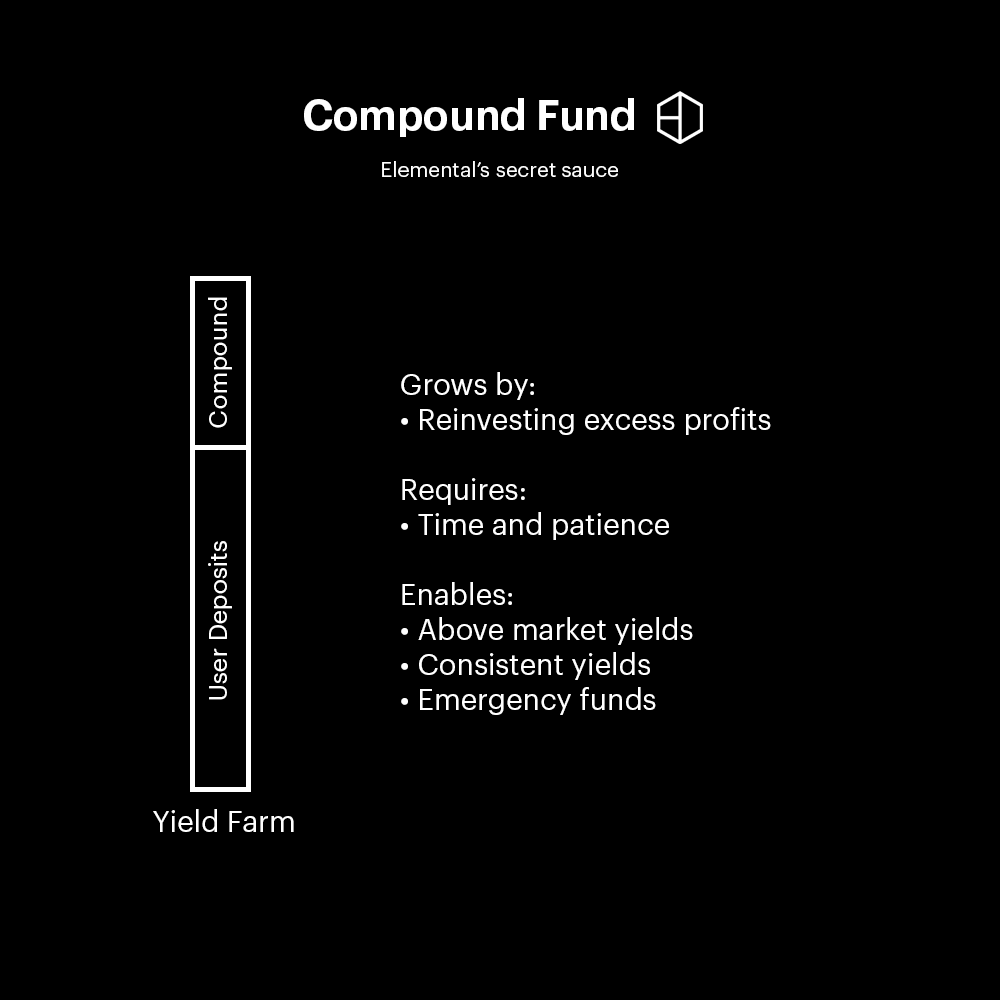
The Compound Fund is an internal reserve that supports the long-term stability and performance of Elemental’s Fixed Deposit system.

It is built by retaining a portion of excess returns generated from deployed capital. Over time, this reserve grows alongside user deposits.

<figure><img src="https://4194917524-files.gitbook.io/~/files/v0/b/gitbook-x-prod.appspot.com/o/spaces%2F2zWf85uxqvZE1rMrFx64%2Fuploads%2Fgit-blob-54251bc241d76b5e76324d229a951d7238ae4300%2Fcompound_fund.png?alt=media" alt=""><figcaption><p>Elemental Compound Fund</p></figcaption></figure>

### How It Works

* When strategy returns exceed the fixed yield distributed to users, the surplus is partially allocated to the Compound Fund
* These retained funds remain within the system and are not distributed immediately
* The reserve compounds over time, strengthening the overall pool

### Role Within The System

The Compound Fund serves three key functions:

**1. Enhancing Yield**\
The Compound Fund is actively deployed alongside user capital, generating its own returns. These additional returns can be fed back into the Fixed Deposit system, allowing for higher overall yields to be distributed.

**2. Supporting Consistency**\
In periods where returns are lower, the reserve may be used to reduce variability in outcomes across epochs.

**3. Providing Operational Buffer**\
The fund acts as an additional layer of resilience in the event of unexpected shortfalls.

### A Long-Term Mechanism

The effectiveness of the Compound Fund increases over time. As it grows, its ability to support the system becomes more meaningful, reinforcing both stability and scalability.


# Partial Unstake

### Overview

Partial Unstake allows you to withdraw a portion of your position while keeping the remaining balance actively deployed.

This provides flexibility to access funds without fully exiting your position.

### How It Works

Enter the amount you wish to withdraw and initiate the request.

For convenience, you may also use the **“Claim Yield”** function, which withdraws your accrued yield without affecting your principal.

Withdrawals are processed in the following order:

1. Accrued yield is withdrawn first
2. If required, the remaining amount is drawn from your deposited capital

Selecting **“Max”** will fully unstake your position.

<figure><img src="https://4194917524-files.gitbook.io/~/files/v0/b/gitbook-x-prod.appspot.com/o/spaces%2F2zWf85uxqvZE1rMrFx64%2Fuploads%2FB0wRb9KVV0gkQRpUYQbn%2Fchrome_1viYorOq9S.png?alt=media&amp;token=498b0eb5-60c8-4b81-80ec-39ea508b2b4d" alt=""><figcaption></figcaption></figure>

### Unstake Timing

All unstake requests follow a fixed cycle and complete after one full epoch.

Each epoch lasts 5 days. The total time required depends on when the request is made within the current cycle.

**Examples**

* If you initiate an unstake 1 hour before the next epoch, your total wait time will be 5 days + 1 hour
* If you initiate an unstake after the start of a new epoch, your total wait time will be close to 5 days + 5 days

In practice, this means the earlier you initiate within an epoch, the longer the total wait time.

{% hint style="info" %}
Unstake requests are queued for the next cycle, then processed over a full epoch.
{% endhint %}

### Important Considerations

* Only one unstake request can be active at any time
* The remaining balance continues to participate in yield generation
* Once initiated, the request will complete at the end of the applicable epoch cycle

<figure><img src="https://4194917524-files.gitbook.io/~/files/v0/b/gitbook-x-prod.appspot.com/o/spaces%2F2zWf85uxqvZE1rMrFx64%2Fuploads%2F0N9e6G0PE6aL6GoRTVGP%2Fchrome_JJFYVmKqhk.png?alt=media&amp;token=eb82ec0a-205b-4247-9013-e0c6da3909d7" alt=""><figcaption></figcaption></figure>

### When to Use Partial Unstake

Partial Unstake is designed for users who want to:

* Access yield without exiting their position
* Adjust exposure over time
* Maintain capital efficiency while retaining flexibility


# Historical Context and Performance

Established in 2022, Elemental has built a strong track record of consistent returns. Our focus extends beyond delivering competitive yields; we’re committed to achieving them through strategies designed to minimize risk. In the volatile world of crypto, achieving short-term stellar gains is easy, but seasoned investors understand that true success lies in protecting against the downside. At Elemental, safeguarding your investments is at the heart of everything we do.

#### Historical Snapshot

In our first two years, from September 2022 to September 2024, Elemental generated approximately 1,000 SOL and 35,000 USDC in user yields. At the time, SOL traded at around $156, bringing total distributed yield to roughly $190,000.

What makes this performance noteworthy is the capital base behind it. In year one, deposits remained below $100,000. By year two, the pool had grown to $500,000. We achieved meaningful yield generation while maintaining disciplined growth and prudent risk management.

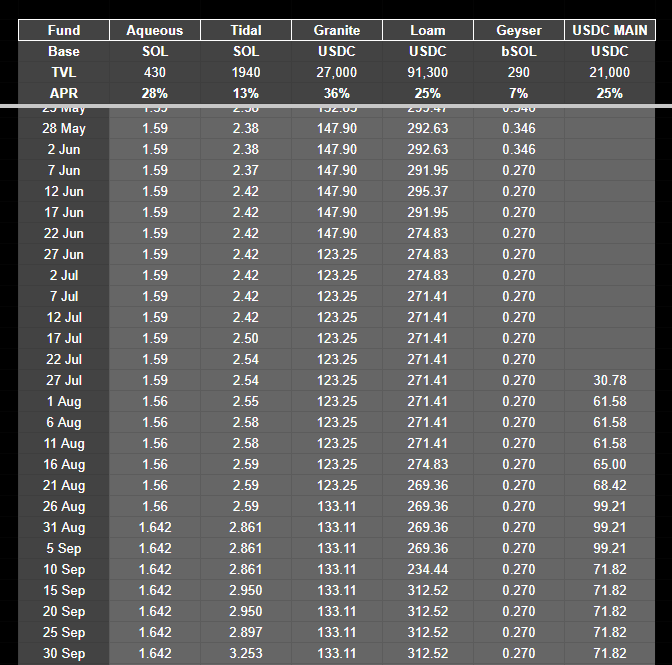
The image below captures a different era. We tracked every deposit and every epoch yield manually in a Google Sheet. There was no website. Access required entry into a private Discord channel, followed by a direct message to Moo for deposit instructions.

It was a period when Web3 was plagued by high profile collapses and audited projects that still failed. By conventional standards, Elemental should not have survived with what many would have described as a pure "trust me bro" setup.

Yet it did.

In an environment where code was immature and infrastructure still developing, trust was not derived from smart contracts alone. It rested on people. Discipline, transparency and integrity carried the operation forward long before the systems matured.

<figure><img src="https://4194917524-files.gitbook.io/~/files/v0/b/gitbook-x-prod.appspot.com/o/spaces%2F2zWf85uxqvZE1rMrFx64%2Fuploads%2Fgit-blob-ad31a8fcfa2614e917333ddbbc03d5f586762fe0%2Fchrome_rEto6HPDGN.png?alt=media" alt=""><figcaption><p>Elemental user yield per epoch per fund</p></figcaption></figure>

Today, Elemental builds on that foundation with greater structure, deeper expertise and a sharper edge. We continue to evolve alongside the shifting crypto landscape, refining strategies that deliver competitive yields while placing risk management and long term sustainability at the centre of every decision.

As we look ahead, our focus remains clear. We exist to provide disciplined, dependable and accessible DeFi opportunities for serious capital, without compromising on prudence or principle.


# Vault Descriptions


# USDC Orca Vault

<figure><img src="https://4194917524-files.gitbook.io/~/files/v0/b/gitbook-x-prod.appspot.com/o/spaces%2F2zWf85uxqvZE1rMrFx64%2Fuploads%2FxP1kQFiiIZU7sa0yzfrI%2Fimage.png?alt=media&amp;token=269f1ebe-954b-4165-ad84-ad63545f5f6e" alt=""><figcaption></figcaption></figure>

### Overview

The USDC Orca Vault provides liquidity for real-world asset (RWA) pairs, with deployment isolated to Orca.

{% hint style="info" %}
At launch, the vault will provide liquidity for the ONyc/USDC pair.
{% endhint %}

The vault is designed to earn yield from liquidity provision, RWA token appreciation, partner emissions, and price arbitrage opportunities. This keeps the strategy simple, capital-efficient, and highly liquid.

### Strategy

When users trade between an RWA token and stablecoins on Orca, they need liquidity on both sides of the market.

The USDC Orca Vault supplies that liquidity.

Elemental deploys capital in highly concentrated ranges, allowing the vault to use capital more efficiently. These ranges are managed through Elemental’s proprietary rebalancing algorithm, which adjusts liquidity placement based on historical data and forward-looking price ranges.

In simple terms, the vault aims to keep capital active where trading is most likely to occur.

By focusing on RWA pairs, users also benefit from exposure to the native RWA token’s yield profile. Combined with partner emissions and price arbitrage opportunities, the vault brings together multiple return sources into a single, streamlined strategy.

### Yield Sources

The vault has a multi-source yield structure. Each source may be modest on its own, but together they are designed to create a competitive overall return profile.

{% stepper %}
{% step %}

#### Trading Fees

When users swap between the RWA token and stablecoins through the liquidity pool, they pay a trading fee. Because the vault provides liquidity to that pool, it earns a share of those fees. By deploying capital in highly concentrated ranges, the vault aims to capture a larger share of pool activity and improve fee efficiency.
{% endstep %}

{% step %}

#### RWA Token Appreciation

RWA tokens may increase in value as their underlying backing assets grow. Because part of the vault’s liquidity is deployed in the RWA token, the vault benefits when the RWA asset appreciates.
{% endstep %}

{% step %}

#### Emissions

Vault partners may provide emissions to further support yields and incentivize liquidity. These emissions are converted into stablecoins and distributed back to users as part of the vault’s yield.
{% endstep %}

{% step %}

#### Price Arbitrage

The vault may also generate additional returns through price arbitrage. When the RWA token trades meaningfully above or below fair value, Elemental may step in to capture the price difference and help improve market efficiency. These opportunities are expected to be occasional rather than constant, so price arbitrage should be viewed as an opportunistic enhancement rather than a fixed component of returns.
{% endstep %}
{% endstepper %}

### Ecosystem Benefit

For depositors, the vault provides access to competitive RWA-focused yield through a strategy that remains simple to use. Users deposit USDC, while Elemental manages liquidity placement, rebalancing, and execution behind the scenes.

For users across the Solana ecosystem, deeper concentrated liquidity creates a better trading experience. Larger swaps can be executed with lower slippage, markets become easier to enter and exit, and price discovery becomes more reliable.

For projects, liquidity is core market infrastructure. By partnering with Elemental, RWA projects gain a dedicated liquidity partner that helps support deeper markets, more stable pricing, and stronger user confidence around their asset.

### Risks

The main strategy-specific risk in this vault is **RWA asset risk**.

If the RWA business performs poorly, the value of its backing assets may decline. In that scenario, the value of the vault will also decline.

Elemental mitigates short term price declines by only engaging with RWA tokens where redemption arrangements are in place with the relevant business. Under normal conditions, this should allow the vault to redeem the RWA token directly back into stablecoins instead of relying only on secondary market liquidity.

However, redemption arrangements do not eliminate all risk. If the RWA business is unable or unwilling to honor redemptions, or if the underlying asset itself is genuinely impaired, the vault may remain exposed to the RWA token and depositors would bear that loss.

As with all DeFi strategies, standard DeFi risks also apply. These include smart contract risk, protocol risk, and broader network risk.

{% hint style="success" %}
The vault does not rely on borrowing. It does not use looping. It does not face liquidation risk from leverage. It also avoids exposure to volatile borrow rates, which can materially affect RWA strategies that depend on lending markets.
{% endhint %}

### Summary

The USDC Orca Vault is designed to make RWA liquidity provision simple for depositors.

Users deposit USDC. Elemental manages execution and rebalancing behind the scenes.

DeFi made simple.

### Protocol Partners

### Orca

Orca is one of Solana’s original leading decentralized exchanges and liquidity venues. The vault deploys exclusively through Orca, allowing Elemental to focus liquidity management, execution, and monitoring within a single venue.

Website: <https://www.orca.so/>

### OnRe

OnRe is the issuer of ONyc and Elemental’s initial RWA partner for this vault. The partnership combines RWA-backed asset exposure with active DeFi liquidity management, supporting a more efficient market for ONyc.

Website: <https://www.onre.finance/>


# ONyc Vault

<figure><img src="https://4194917524-files.gitbook.io/~/files/v0/b/gitbook-x-prod.appspot.com/o/spaces%2F2zWf85uxqvZE1rMrFx64%2Fuploads%2FUzcjL6ao6eyJAtFSBodz%2Fonre_elemental.png?alt=media&amp;token=8c367f74-8f60-4195-8467-668a9b9e520f" alt=""><figcaption></figcaption></figure>

### Overview

The ONyc Vault marks a significant step forward in Elemental’s evolution. For the first time, we are moving beyond pure stablecoin strategies and into real world assets (RWA).

It also represents our first true multi-partner deployment. To bring this vault to life, we collaborated with OnRe, the issuer of ONyc, alongside various Solana protocols including Kamino, Loopscale, and Carrot. This integration reflects both the depth of the Solana ecosystem and the power of composability.

More importantly, this partnership strengthens the portfolio construction of Elemental itself.

OnRe provides an uncorrelated yield source relative to traditional on-chain strategies. In practical terms, this means Elemental depositors are no longer exposed to a single yield regime. By introducing RWA backed yield into our ecosystem, we reduce dependency on purely crypto native flows and add structural diversification.

For those interested in the theoretical foundation behind this approach, you can read more about the [Efficient Frontier](/elemental-library/efficient-frontier).

Diversification is not about chasing more yield. It is about building resilience.

### Strategy

Risk management remains central to our philosophy. Deploying across multiple protocols reduces concentration risk and avoids overexposure to any single venue.

Looping will serve as the primary efficiency enhancer at launch. However, we will not pursue maximum theoretical leverage. We deliberately cap leverage at levels where the risk reward profile remains compelling and defensible.

Higher yields naturally introduce higher risk. Beyond a certain point, incremental return does not justify incremental fragility. Our objective is not to extract every basis point. It is to deliver durable, repeatable performance.

As OnRe expands its integrations across Solana DeFi, the strategy set available to this vault will broaden. We will adapt accordingly, with continuous monitoring and disciplined adjustments to maintain an optimal balance between return and stability.

True to our ethos of making DeFi simple, users take a single action: deposit. Elemental manages the operational complexity behind the scenes.

### Yields and Points

This vault introduces a dual yield structure.

Depositors benefit from ONyc’s native yield, alongside enhanced returns generated through Elemental’s DeFi deployment strategies.

In addition, we will track qualifying deposits for participation in OnRe’s points programme, ensuring users capture the full spectrum of potential upside associated with the ecosystem.

### Vault Capacity

Elemental is a rare protocol that prioritizes yield quality over TVL growth. Any experienced asset manager understands that scale can compress returns.

This vault will be no exception.

Capacity will be managed in coordination with OnRe and our DeFi partners. We will expand only when markets can absorb additional capital without materially diluting yields.

Discipline ensures longevity. Growth without discipline erodes edge.

### Protocol Partners

#### Kamino

Kamino is an open source credit and liquidity protocol on Solana, enabling borrowing, lending, and automated yield through transparent, risk-managed markets for users and institutions.

Website: <https://kamino.com/>

#### Loopscale

Loopscale is a modular, order book–based lending protocol on Solana. It enables overcollateralized borrowing and lending across a wide range of digital assets, including staked tokens, liquidity provider positions, and more specialized primitives.

Website: <https://loopscale.com/>

### Additional Reading

The Elemental Edge:\
<https://www.onre.finance/blog/the-elemental-edge-when-resilient-rwa-yield-meets-risk-averse-onchain-deployment>


# Introduction to Strategies

### Making Complex DeFi Strategies Simple

At Elemental, we research and build infrastructure that allows users to participate in complex DeFi strategies, staying true to our vision of making DeFi simple.

Within each vault, proprietary algorithmic systems support the execution of specific strategies designed to earn competitive yields for users. These systems help automate key parts of the strategy process, including position management, execution optimization, and ongoing monitoring.

### A Range of Strategies, Each With Different Risk Profiles

Elemental supports multiple vaults, each built around different DeFi strategies and sources of return. Every strategy carries its own risk profile, market sensitivity, and operational considerations.

Users should conduct their own research and decide which vaults they are comfortable participating in, based on their own objectives, risk tolerance, and desired level of portfolio diversification.

Diversification is important because no single strategy performs well in every market environment. For example, funding rate strategies may be highly productive during strong bull markets, but can become flat or even negative during quieter or bearish periods.

By participating across different vaults and strategies, users may reduce concentration risk and create more balanced exposure across changing market conditions.

### Staying Nimble Without Chasing Hype

The Web3 landscape changes quickly, and Elemental remains open to new opportunities as they emerge. However, we do not believe in chasing every trend or launching vaults purely because a narrative is popular.

Our approach is to balance exploration with discipline.

We assess opportunities through market data, first-hand DeFi experience, protocol relationships, and internal research. This allows us to evaluate whether a strategy is sufficiently robust, liquid, and sustainable before making it available through our infrastructure.

As a result, Elemental may not always support the latest hype cycle or the highest advertised yield. Our bias is toward risk minimization, reliable execution, and long-term resilience rather than speculative yield maximization.

### Our Edge Is in Execution

The following pages provide a non-exhaustive overview of the strategies that Elemental researches, builds infrastructure for, and supports through its vault systems.

While many of these strategies can theoretically be attempted by anyone, our core advantage lies in how they are executed.

{% hint style="info" %}
For [funding rate](/strategies/funding-rate-farming) strategies, our proprietary algorithms are designed to enter, manage, and exit positions with minimal execution cost. In certain market conditions, execution itself may even contribute positively to performance.
{% endhint %}

{% hint style="info" %}
For [liquidity provision](/strategies/provisioning-in-liquidity-pools) strategies, our systems aim to improve forecasting, capital positioning, and concentration management. This may allow vaults to capture yield more efficiently than less optimized approaches.
{% endhint %}

Across all strategies, Elemental focuses on execution quality, operational discipline, and careful strategy design.

### Built on Solana, Verifiable On-Chain

Elemental operates exclusively on Solana. This allows vault activity to be executed and verified on-chain, giving users greater transparency into how strategies interact with protocols and how positions are managed.

This on-chain structure reinforces accountability. It allows users to observe strategy behavior directly, rather than relying solely on off-chain reporting or opaque execution.

We believe this transparency is an important part of building trust in DeFi infrastructure.

### Important Information

All information provided in this document is for general informational purposes only.

Nothing in this document should be interpreted as financial advice, investment advice, fund management services, or a recommendation to participate in any particular vault, strategy, or protocol.

All DeFi activity involves risk, including smart contract risk, market risk, liquidity risk, oracle risk, protocol risk, execution risk, and potential loss of capital.

Users are responsible for conducting their own due diligence and making their own decisions before deploying capital into any vault or strategy.


# Funding Rate Farming

Recommended Reading Before Starting: [Perpetuals](/elemental-library/perpetuals), [Funding Rates](/elemental-library/funding-rates)

#### Overview

One strategy we employ at Elemental is delta-neutral [funding rate](/elemental-library/funding-rates) farming. In a bull market, [perpetual](/elemental-library/perpetuals) ("perp") contracts often trade at a premium to their underlying assets because most traders anticipate rising prices. Under these conditions, long positions pay shorts a funding rate, creating an opportunity for those holding short positions to earn a steady stream of income. This income can become substantial in a strong bull market and often grows even larger when dealing with smaller-cap tokens.

#### Creating a Delta-Neutral Position

While short positions earn funding payments, they also carry directional risk if held alone. As a fund, we aim to avoid exposure to an asset’s price movement. To achieve this neutrality, we balance a short perp position with an equal spot holding. For example, if we open a 1,000 SOL short in the perp market, we simultaneously hold 1,000 SOL in our spot portfolio. This delta-neutral stance ensures that our overall portfolio value remains stable, regardless of whether SOL’s price rises or falls. Once established, this balanced position allows us to collect funding payments without worrying about price volatility.

#### A Portfolio Approach to Funding Rate Stability

Funding-rate strategies can offer good income, but the rates themselves are volatile. They can swing meaningfully over short periods. The example chart below illustrates how a single token’s funding rate shifted over the course of a month.

A practical way to reduce this volatility is to diversify across several tokens. Each asset follows its own market dynamics, so spreading exposure helps smooth overall returns and creates a more resilient portfolio.

<figure><img src="https://4194917524-files.gitbook.io/~/files/v0/b/gitbook-x-prod.appspot.com/o/spaces%2F2zWf85uxqvZE1rMrFx64%2Fuploads%2F2ZLKvEXMKlsPzjSHCG43%2FUZb4lC3AFW.png?alt=media&amp;token=ee74b791-358d-49e9-ae16-88130ec98c4c" alt=""><figcaption><p>Volatile funding rates</p></figcaption></figure>

#### Adaptive Allocation When Funding Turns Adverse

At times, funding rates can remain negative for extended periods. This typically occurs during bearish conditions when market participants expect continued weakness. As a result, perpetual prices trade persistently below spot, making funding-rate farming unattractive.

During these periods, it is prudent to pause the strategy rather than force returns. Elemental remains highly active in these scenarios, reallocating capital into alternative strategies that continue to perform, ensuring the portfolio remains productive and protected.

#### Proprietary Execution Scripts: The Elemental Advantage

At Elemental, our edge lies not only in the strategies we deploy but in how efficiently we execute them. Our proprietary trading scripts have been engineered to achieve exceptionally low execution costs - on average 0.05% per trade, compared to the 0.5%–1.0% typically incurred by other funds.

Below is an example of Elemental executing a delta-neutral position with approximately $400,000 in capital - purchasing spot SOL while simultaneously opening short SOL perpetuals. The entire operation was completed at an exceptionally low execution cost of just 0.0123% despite being executed under unfavorable market conditions.

<div align="center"><figure><img src="https://4194917524-files.gitbook.io/~/files/v0/b/gitbook-x-prod.appspot.com/o/spaces%2F2zWf85uxqvZE1rMrFx64%2Fuploads%2FrV7Lwc1in59HE6ws6n88%2Fimage.png?alt=media&amp;token=dddfe369-44d0-4ae5-8fde-84f039d5e602" alt=""><figcaption><p>Elemental scripts in action</p></figcaption></figure></div>

This near-zero cost basis fundamentally enhances our operational agility. It allows us to enter and exit positions with exceptional speed and efficiency, free from the friction that often traps other funds in underperforming strategies. While conventional funds may hesitate (holding on in the hope that a lagging position will recover) we can reallocate capital instantly and with precision, avoiding unnecessary losses and continually pursuing higher-yielding opportunities.

We believe that over time, strategies will become commoditized. What will remain scarce, however, is execution mastery - the ability to execute more efficiently than the rest. This is where Elemental continues to lead. Our engineering team devotes significant resources to refining, testing, and iterating these proprietary systems to stay ahead of evolving market conditions.

Ultimately, our scripts form our moat, ensuring that even as the broader DeFi landscape grows more competitive, Elemental remains at the forefront of consistent, high-performance yield generation.


# Provisioning in Liquidity Pools

### Overview

Liquidity pools form the bedrock of decentralized finance (“DeFi”). They are the mechanism that allows users to swap freely between tokens without relying on traditional order books or centralized intermediaries.

In these pools, users known as liquidity providers (“LPs”) deposit pairs of assets into automated market makers (“AMMs”). Each time a swap occurs, a small fee is charged and distributed proportionally to LPs, creating a sustainable and organic source of yield within DeFi.

### The Evolution of Liquidity Provision

When AMMs were first introduced, liquidity was deployed uniformly across the full price spectrum. This design was groundbreaking for its time, but highly capital-inefficient, as most liquidity sat unused in price ranges far away from where actual trading occurred.

Newer innovations, such as concentrated liquidity, transformed this model. Providers can now allocate their capital within narrower, active price ranges, allowing for greater capital efficiency and higher yield potential.

By focusing liquidity where trading happens most frequently, each dollar of capital deployed can generate significantly more in fees.

### Elemental’s Liquidity Pool Strategies

At Elemental, we research and build infrastructure for liquidity provision strategies across different market conditions, asset types, and risk profiles.

Our goal is not simply to place liquidity into pools and wait. The edge comes from understanding where liquidity should be deployed, how tightly it should be concentrated, when it should be rebalanced, and how the underlying assets are expected to move over time.

This is especially important because different pools behave differently. A stablecoin pair, a liquid staking token pair, and an RWA pair may all look similar on the surface, but the mechanics behind their price movement, yield accrual, and liquidity behavior can be very different.

### Highly Concentrated Stable Pools

In pools where both assets maintain a tight price relationship, such as stablecoin pairs, liquidity can often be deployed within very narrow price bands.

This allows the vault to capture consistent trading fees while minimizing unnecessary exposure to wider price movements.

However, precision matters. A narrow range can improve capital efficiency, but it also requires careful monitoring. If the price moves outside the active range, the position stops earning fees until it is rebalanced or the price returns.

Elemental’s infrastructure is designed to support this process through active range monitoring, execution optimization, and disciplined rebalancing.

### Drift Strategies With Yield-Bearing Tokens

For pools that include yield-bearing assets, liquidity provision becomes more nuanced.

These may include liquid staking tokens, yield-bearing stablecoins, or real-world asset (“RWA”) tokens. While each asset type has different mechanics, they share one important feature: their fair value may drift over time.

This drift can happen because of staking rewards, embedded yield, income distribution, changes in redemption value, or the performance of the underlying asset. As a result, the optimal liquidity range may not always be centered around the current market price.

Instead, the range should reflect where the asset pair is expected to move.

For example, if one asset is expected to gradually appreciate relative to the other because it is accruing yield, the liquidity range may need to be positioned slightly ahead of the current price. This allows the vault to keep liquidity active for longer, capture more trading fees, and reduce unnecessary rebalancing.

RWA tokens add another layer of complexity because their price behavior may also be influenced by off-chain business performance, redemption mechanics, liquidity depth, market confidence, and the yield profile of the underlying real-world assets.

This means RWA liquidity provision cannot rely only on surface-level price stability. It requires a deeper understanding of the asset itself, the mechanics behind its value, and the potential scenarios that could cause the pool to become imbalanced.

Elemental’s approach is to study these dynamics before deciding how ranges should be setup. This includes assessing expected price behavior, liquidity conditions, and pool depth, among other things.

When executed well, drift-based liquidity provision can combine multiple yield sources, including swap fees, token emissions, embedded asset yield, and potential market-making gains.

### Deep Understanding

At Elemental, our advantage lies not in generic automation, but in a deep understanding of the assets that make up each liquidity pool.

Every token behaves differently.

Two yield-bearing assets may accrue value in completely different ways. One may increase gradually over time, while another may deliver most of its yield through periodic adjustments. An RWA token may trade within a tight range for long periods, then move sharply if market sentiment or underlying business conditions change.

These details matter.

By understanding how each asset accrues value, how its price is likely to drift, and how liquidity tends to behave around it, Elemental can design more precise deployment and rebalancing logic.

This allows our infrastructure to support liquidity strategies that are more targeted, more capital-efficient, and more responsive to market conditions.

### Execution Is the Edge

Many participants can provide liquidity. Fewer can do it with precision.

The real challenge is not knowing that a pool exists. It is knowing where to place liquidity, how concentrated the position should be, how often it should be adjusted, and whether the yield adequately compensates for the risk.

Elemental’s proprietary systems are built to support this execution layer.

Through forecasting, monitoring, and optimized rebalancing, our infrastructure aims to keep liquidity active in the most relevant ranges while avoiding unnecessary churn and execution costs.

This is where the strategy becomes more than passive LPing. It becomes a disciplined process of liquidity engineering.


# Lending Loops

Writeup coming soon.


# Arbitrage

Writeup coming soon.


# Introduction to Elemental Lend

### Overview

Elemental Lend is a **yield aggregator** engineered to maximize lending returns on Solana. By continuously monitoring rates across the ecosystem, it dynamically reallocates capital to capture the best rates in real time.

<figure><img src="https://4194917524-files.gitbook.io/~/files/v0/b/gitbook-x-prod.appspot.com/o/spaces%2F2zWf85uxqvZE1rMrFx64%2Fuploads%2FSuLfOmj8Iyn6qps8WIKc%2Felemental_lend_card.png?alt=media&amp;token=be27ab5a-0749-45a2-8595-f7c717f2260a" alt=""><figcaption><p>Elemental Lend</p></figcaption></figure>


# Protocol Mechanics

#### Yield Aggregation

At its core, Elemental Lend *aggregates the best lending yields* available across the Solana ecosystem.&#x20;

{% hint style="success" %}
Elemental Lend ensures your capital is always earning the highest yield available.
{% endhint %}

It does this through a proprietary smart routing algorithm that continuously monitors lending rates across major platforms and automatically directs deposits to wherever returns are currently highest.

The protocol consistently outperforms single lending pools because its deposits are not fixed to one source of yield. Yields fluctuate constantly across different pools - rising and falling as liquidity and market conditions shift. A single pool will naturally experience both the highs and the lows, which reduces its average return over time.

Elemental Lend avoids this limitation by dynamically reallocating capital to whichever platform offers the highest yield at any given moment. This allows it to capture multiple peaks across platforms while sidestepping the dips, maintaining a higher average yield overall.

Consider this simple example of just two lending pools:

* **Lending Pool A** averages 2.5%
* **Lending Pool B** averages 5.0%
* **Elemental Lend**, by routing between them, achieves an average of **7.5%**

<figure><img src="https://4194917524-files.gitbook.io/~/files/v0/b/gitbook-x-prod.appspot.com/o/spaces%2F2zWf85uxqvZE1rMrFx64%2Fuploads%2Fz8bf8hRKgu3DHJgxt5mo%2Fyield_aggregator_outperformance.png?alt=media&amp;token=985948ae-84f9-4790-947c-c88159b9dba4" alt=""><figcaption><p>Elemental Lend Yield Aggregator Illustration</p></figcaption></figure>

From this illustration, it’s clear how the protocol delivers consistently higher returns simply through smart, adaptive routing.

{% hint style="info" %}
As the number of integrated pools increases over time, performance improves even further since each additional pool creates more opportunities to capture yield peaks and minimizes exposure to dips.
{% endhint %}

#### Integrations

At the time of writing, Elemental Lend is integrated with two leading lending protocols:&#x20;

* [Kamino](https://kamino.com/)
* [Jupiter Lend](https://jup.ag/lend/earn)

These platforms were selected for their size, liquidity depth, and operational resilience, helping to ensure that counterparty and systemic risks remain minimal.

Yields within these protocols are generated from fees paid by borrowers. These fees are distributed between depositors and the protocol itself. The balance of assets supplied and borrowed directly influences yield levels; as capital moves in and out of pools, yields naturally fluctuate in response to changing demand and supply.

Well-designed lending protocols feature robust liquidation mechanisms that account for the varying risk profiles of different tokens. By applying distinct collateral and liquidation thresholds, they ensure efficient liquidations and help prevent bad debt.

Because of these safeguards and the transparent, overcollateralized nature of on-chain lending, lending pools are widely regarded as one of the lowest-risk sources of yield in DeFi.

{% hint style="info" %}
IMPORTANT: Lending is not without risk. Although lending pools are typically viewed as lower-risk within DeFi, they remain exposed to bad debt, smart contract vulnerabilities, and other potential exploits. As with most of DeFi, your entire capital is at risk and returns are never guaranteed.
{% endhint %}


# Protocol Architecture


# Audit and Transparency

#### Non-custodial Vaults

When you deposit into Elemental Lend, your assets are held in a Voltr non-custodial vault. This means Elemental never holds user deposits directly.

Voltr provides secure vault infrastructure that allows managers like Elemental to deploy capital only within approved, whitelisted strategies under strict smart-contract controls. Elemental has management access, but not custody. It can allocate funds between authorized strategies, but it cannot withdraw user assets.

This architecture ensures that depositor funds remain fully protected at all times.

#### Audit

Voltr's vaults have been audited by Sec3 X-Ray and FYEO. Both audits are smart-contract reviews and all identified vulnerabilities, ranging from low-severity optimizations to higher-impact logic issues have been addressed and remediated.

{% file src="/files/wCf3uWwNZ3Mx1r70jQDu" %}
Sec3 X-Ray Audit Report
{% endfile %}

{% file src="/files/OV1R9apTm2lc9b8V4K4N" %}
FYEO Audit Report
{% endfile %}

#### Transparency

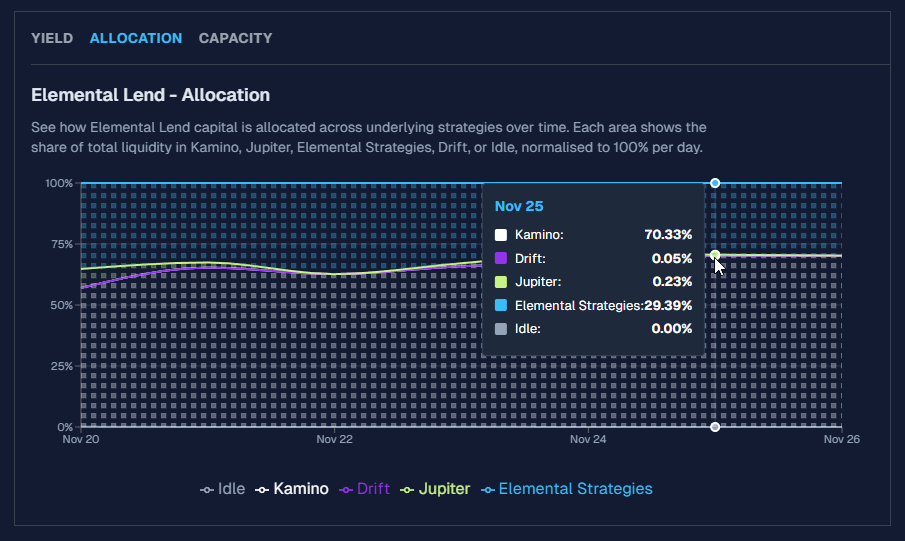
Elemental also provides complete visibility into the fund allocation. The main website dynamically displays how assets are distributed across integrated protocols, allowing depositors to verify allocations in real time. It also logs the history of how these allocations have changed over time.

Elemental offers full visibility into how capital is deployed. Our platform tracks allocations across integrated protocol in real time, giving depositors a clear view of where their funds are working at any moment. The dashboard also records historical allocation patterns, so users can easily understand how allocations evolve over time.

<figure><img src="https://4194917524-files.gitbook.io/~/files/v0/b/gitbook-x-prod.appspot.com/o/spaces%2F2zWf85uxqvZE1rMrFx64%2Fuploads%2FQsD8fggG8vyFNV73Ru7W%2Fimage.png?alt=media&amp;token=b0427591-2c27-45b7-b780-d87eda5fef84" alt=""><figcaption><p>Elemental Lend Allocation</p></figcaption></figure>

The chart illustrates how Elemental Lend capital moves across the underlying protocols, normalized to 100%. This helps depositors validate not just the current mix, but also the rhythm and responsiveness of the system as market conditions shift.

Transparency is not an afterthought - it’s a core design principle.


# Outperformance Share

#### Outperformance Share

Elemental only takes a cut from the excess yield we generate above the second-best lending opportunity in the ecosystem. Depositors keep the entire baseline yield; we split half the Outperformance created by our protocol. If we don’t outperform, we take nothing. This ensures complete alignment - we win only when you do.

The table below illustrates how this works in practice.

|             | Elemental Lend | Fund A | Fund B | Fund C |
| ----------- | -------------- | ------ | ------ | ------ |
| Scenario I  | 8.3%           | 5.4%   | 7.8%   | 7.2%   |
| Scenario II | 8.3%           | 5.4%   | 7.8%   | 8.4%   |

Scenario I

Elemental Lend delivers the highest yield at 8.3%.\
The next best-performing fund is Fund B at 7.8%.

* **Outperformance = 8.3% – 7.8% = 0.5%**
* Outperformance is shared 50/50.
* Depositors receive: **8.3% + 0.25% = 8.55%**
* Elemental receives: **0.25%**

Scenario II

Fund C outperforms Elemental with an 8.4% yield.

* Elemental does **not** outperform.
* Depositors receive the full **8.3%**, with no Outperformance Share deducted.

{% hint style="info" %}
IMPORTANT: The yield displayed to users on our website already factors in all Outperformance-sharing calculations. The numbers shown here are for educational purposes only - they simply illustrate how Outperformance is determined.
{% endhint %}


# Deposits, Withdrawals, and Yield Accrual

#### Deposits and Withdrawals

Elemental Lend supports instant deposits and withdrawals, giving depositors uninterrupted access to their capital. When you deposit, funds are immediately routed to the highest-yielding opportunity available across our integrated pools. Yield generation begins the moment your liquidity is deployed.

Withdrawals follow the same principle: they settle instantly as long as sufficient unutilized liquidity is available. This design gives users the flexibility of a money-market protocol with the yield optimization of an actively managed lending router.

#### **Yield Accrual and Balance Updates**

Yield accrues continuously from the underlying lending venues, but your on-chain balance updates only when a triggering event occurs. These “crank events” include:

* A new deposit
* A withdrawal
* Reallocation of capital between integrated pools
* A claim of accrued yield

Each event prompts a refresh of user balances and distributes accumulated yield proportionally. This approach ensures accurate accounting while reducing gas expenditure thereby improving capital efficiency.

The result is a system where your yield is always accruing, even if visible updates appear intermittently.

#### **Utilization Rate and Liquidity Availability**

As with any lending protocol, withdrawals depend on the utilization rate of the pool. You can withdraw up to the portion of liquidity not currently lent out. When utilization is high, available liquidity may temporarily be insufficient to satisfy large withdrawals.

In these moments:

* Higher utilization leads to higher yields, incentivizing liquidity providers to remain in the pool or add new capital.
* Borrowing becomes more expensive, discouraging additional borrowing and encouraging existing borrowers to repay.

These opposing incentives create a natural stabilizing effect, helping the pool cycle back towards healthier liquidity levels.

However, it is important to recognize that extreme conditions, such as market stress or simultaneous large withdrawal attempts, may still result in temporary illiquidity. In such cases, withdrawals will succeed once borrowers repay or new liquidity enters the pool.

This behavior is typical of all lending markets, and is an inherent characteristic of pooled credit systems.


# Operational Logic and Algorithm Design

#### Smart Routing Algorithm

Elemental’s smart routing algorithm continuously analyses yields and price impact across all supported pools every few minutes. When certain thresholds are met, it automatically rebalances deposits to optimize returns, otherwise it maintains its current deployment.

This approach strikes an optimal balance between minimizing rebalancing costs and maximizing yield efficiency - ensuring that capital is always working in the most productive configuration without unnecessary transaction overhead.

#### Sub-vaults

In protocols such as Kamino, many lending pools exist. Running a single global algorithm across all of them would be computationally expensive, as the calculations grow exponentially with each additional pool.

To address this, Elemental employs a main and sub-vault architecture. Each sub-vault operates within a specific protocol and runs its own local optimization algorithm. The main vault’s algorithm then coordinates only at the protocol level, deciding how to allocate funds among the various sub-vaults.

This layered approach dramatically improves efficiency, allowing Elemental to scale efficiently.

#### Redundancies

Because the smart routing algorithm must operate continuously, Elemental maintains three RPC endpoints to ensure uninterrupted performance. If one endpoint experiences downtime, the next takes over automatically - with an additional backup ready if needed.

While this setup cannot make the system completely fail-safe, it provides a strong layer of operational resilience. Even in the unlikely event that all algorithmic processes pause, funds remain safely within their respective protocols until the system restores and rebalances them.


# Yield Performance

Elemental Lend is designed to consistently outperform standalone lending protocols by dynamically allocating capital to the most attractive opportunities across the Solana ecosystem. Rather than remaining exposed to a single source of yield, the protocol continuously rebalances positions to capture the highest available rates at any given time.

<figure><img src="https://4194917524-files.gitbook.io/~/files/v0/b/gitbook-x-prod.appspot.com/o/spaces%2F2zWf85uxqvZE1rMrFx64%2Fuploads%2FO9wckwFFj9Bux7WBIst2%2Fusdc_lend_yield_performance.png?alt=media&amp;token=5ae40860-5e3c-44a2-bbe7-37f22f441e67" alt=""><figcaption><p>Elemental Lend USDC 180 day performance comparison</p></figcaption></figure>

The chart above illustrates Elemental Lend’s performance relative to leading lending protocols over 180 days since its inception The results demonstrate not only higher average yields, but also greater consistency of returns. By aggregating yield across multiple platforms, Elemental Lend is able to capture upside opportunities while reducing prolonged exposure to lower-yielding environments.

As yield conditions shift across protocols due to changes in supply and demand, Elemental adapts continuously, ensuring capital remains efficiently deployed. Over time, this allows the strategy to compound incremental advantages that individual pools cannot achieve in isolation.

{% hint style="info" %}
**Why aggregation leads to consistent outperformance**<br>

Individual lending pools experience cyclical fluctuations in yield, often driven by short-term imbalances in liquidity. By rebalancing dynamically, Elemental Lend captures yield peaks across platforms while concurrently avoiding extended periods of suppressed returns. As more integrations are added, this advantage compounds further by expanding the opportunity set.
{% endhint %}

While historical performance reflects the effectiveness of this approach, yields remain variable and dependent on broader market conditions. Elemental’s objective is not to maximize short-term returns, but to deliver sustainable, risk-adjusted yield over time through disciplined and adaptive capital allocation.


# FAQ

## **General Questions**

#### **Q:** Which blockchain does Elemental operate on?

A: Elemental runs entirely on the Solana blockchain. We believe in a decentralized future, and building on-chain ensures unmatched transparency and trust.

#### Q: What tokens does Elemental work with?

A: Elemental operates funds denominated in USDC, SOL, and ONyc. Since we’re on Solana, we utilize SPL (Solana Program Library) tokens, which are fully compatible with the Solana ecosystem.

## Yield Questions

#### **Q: Where do the yields come from?**

A: Our yields come from various DeFi protocols on the Solana ecosystem, which offer diverse yield and arbitrage opportunities. These include funding rate farming, liquidity provision for stable pairs, vanilla lending, and lending loops, arbitrage, and more. Each carries unique risks and is rigorously monitored to optimize returns.

#### **Q: Are the yields sustainable?**

A: Our yields depend on external sources and remain sustainable as long as these sources exist. However, we expect yields to diminish over time as markets become more efficient and competition increases.

#### **Q:** How can you offer a fixed yield?

A: We maintain a [Compound Fund](/elemental-fixed-deposit/compound-fund) to buffer against revenue fluctuations. While the yield is fixed during each Elemental Epoch, it may be adjusted between epochs. We aim to minimize adjustments and ensure stability for our depositors.

#### **Q: Do my yields compound?**

A: Yes for Lend, no for Fixed Deposit. For Fixed Deposit, our yields are calculated on your initial capital, which is why we display them as APR rather than APY. However, this does not mean your returns are stagnant. Elemental uses complex strategies behind the scenes but provides a simple user interface. The competitive yields you receive result from rigorous back-testing and forward estimates of these strategies, enabling us to offer the fixed yields as advertised. Rest assured, no capital in Elemental remains idle; every portion of your funds is actively deployed to generate the returns we provide.

#### **Q:** Will Elemental’s yields decrease over time?

A: Not necessarily. While market yields may decline, Elemental compounds a portion of its gains. Over time, this compounding effect can lead to rising yields, assuming other factors remain constant.

## Deposit and Withdrawal Questions

#### **Q: When can I deposit?**

A: Deposits are accepted as long as our funds have capacity. For Lend, your capital gets activated immediately, and for Fixed Deposit it will activate at the start of the next epoch. While your funds are in the queue, you will not be able to initiate any unstaking; you can only unstake once your deposit has started farming. Because we prioritize competitive yields, our fund capacity is limited. If the funds are full, we appreciate your patience until more capacity becomes available.

#### **Q: When can I withdraw?**

A: For Lend, immediately. For Fixed Deposit, you can initiate the unstake process at any time. However, you must wait through one full [Elemental Epoch](https://docs.elemental.fund/elemental-epoch) after requesting the unstake before your funds become accessible. For example, if you initiate an unstake on 2 Dec, you must wait for the epoch from 5 Dec to 10 Dec to complete, and your funds will be subsequently available on 10 Dec. This short delay allows us to unwind more complex positions that may require several days.

#### Q: Do I earn yields while waiting to unstake?

A: Yields are not accrued during the unstaking epoch as your funds are being unwound and therefore not earning yields. However, yields for the current epoch are credited at its start so you would get the full amount. For example, if an epoch runs from 5 Dec to 10 Dec, yields for this period are credited up front on 5 Dec.

## **Risk Questions**

#### **Q:** Is there a risk of losing money with Elemental?

A: Yes. Like any financial vehicle, investing with Elemental carries risks. Potential threats include protocol exploits, token depegging, bridge hacks, and more. Our team actively monitors conditions to mitigate risks, but we encourage you to review our [Risk Disclosures](/risk-disclosures) for more details.

#### **Q:** What happens if the fund incurs losses?

A: Elemental has our Compound Fund as the primary safeguard - it provides an additional layer of protection. If losses exceed what is available in the Compound Fund, the remaining amount will be distributed proportionally among affected depositors. Please refer to our [Risk Disclosures](/risk-disclosures) for more information.

#### **Q: Are your smart contracts audited?**

A: Yes for our Lend product, no for our Fixed Deposit product. In FIxed Deposit, our processes are manually executed and not governed by smart contracts, so there is no code to audit. We focus on strong internal controls and risk management. All investments are conducted on-chain on Solana, ensuring full transparency.

## Other Miscellaneous Questions

#### **Q: What is an Elemental Epoch?**

A: An Elemental Epoch is a 5-day period during which yields are fixed. Epochs start and end at 0200h UTC. View a sample schedule here: [Elemental Epoch](/elemental-epoch).

#### **Q:** How does Elemental cover its operational costs?

A: Elemental's model is designed for long-term growth and sustainability. After fulfilling user yields and other obligations, remaining profits are used for operational costs, such as staff salaries. For a visual breakdown [here](/elemental-fixed-deposit/infographic).

#### **Q: I'm interested! How do I get started?**

A: We’re excited to have you onboard! Visit [elemental.fund](https://elemental.fund/) to deposit and begin your journey with Elemental.


# Elemental Epoch

At Elemental, we follow our own unique epoch schedule, with each epoch spanning 5 days. Each epoch begins and ends at 0200h UTC. Below are the start and end dates for a selection of sample epochs.

## Epoch Schedule Sample <a href="#epoch-schedule-sample" id="epoch-schedule-sample"></a>

0200h UTC, 30 Dec 2023

0200h UTC, 04 Jan 2024

0200h UTC, 09 Jan 2024

0200h UTC, 14 Jan 2024

0200h UTC, 19 Jan 2024

0200h UTC, 24 Jan 2024

0200h UTC, 29 Jan 2024

0200h UTC, 03 Feb 2024


# Risk Disclosures

#### 1. **Human Error in Fund Management**

Although our smart contracts handle deposits, yield tracking, and withdrawals, the investment decisions and deployment are ultimately made by our team. This human factor may lead to errors in judgment or execution, potentially affecting fund performance.

#### **2.** Market Volatility and Liquidation Risks

Elemental seeks to generate yield in a disciplined and sustainable manner; however, certain strategies are subject to defined liquidation thresholds. Positions are actively monitored and structured to withstand typical market fluctuations, but extreme volatility may exceed these parameters. In such scenarios, rapid and significant price movements can trigger liquidations, resulting in realised losses.

#### **3. Depegging and Oracle Risks**

Elemental’s strategies are designed to be non-directional and do not rely on predicting asset price movements for returns. However, they remain exposed to price dynamics through collateral requirements and liquidation thresholds. Positions are actively managed to maintain prudent buffers, but events such as depegging or errors in oracle price feeds can distort valuations and trigger liquidations, potentially impacting fund performance.

#### **4. Protocol Risks**

Funds are deployed into DeFi protocols on the Solana blockchain. These protocols may have vulnerabilities, exploits, or bugs in their smart contracts, which could lead to partial or total loss of the invested funds. Elemental does not underwrite these risks, and any losses incurred will be reflected proportionately in user deposits.

#### **5. Bridged Token Risks**

Some strategies involve bridged tokens, which rely on cross-chain bridges. These bridges may have security vulnerabilities that could result in significant losses if compromised.

#### **6. Regulatory Risks**

Cryptocurrency regulations are subject to change. Shifts in legal frameworks, varying by jurisdiction, could impose constraints or obligations on our operations that may adversely affect our strategies.

#### **7. Risk of Theft and Cyber Attacks**

Despite security measures, the potential for theft or cyber attacks remains. Hacking, phishing, social engineering, or other malicious activities could compromise digital wallets or other infrastructure, resulting in asset loss.

#### **8. Additional Risks and User Acknowledgment**

The risks outlined herein do not cover every possible risk associated with Elemental or the broader cryptocurrency markets. By depositing funds with us, you acknowledge and accept the inherent risks of digital asset investment, including the potential for **total and irrecoverable loss of capital**. You understand and agree that any reliance on our platform and services is undertaken at your sole risk and discretion.

#### **9. Waiver of Claims and Limitation of Liability**

By using Elemental’s platform, you confirm that you have read, understood, and accepted all risks described in this disclosure. You further agree to waive any right to legal action against Elemental, its officers, employees, and affiliates for any claims or losses arising from your participation, unless explicitly stipulated otherwise by applicable law. This waiver includes, but is not limited to, losses resulting from human error, protocol exploits, cyber attacks, or regulatory changes.


# Manifesto

Our beliefs and goals.

## Preface <a href="#preface" id="preface"></a>

The different interpretations of Elemental.

### **Elemental = Fundamental**

The word "elemental" refers to an essential constituent of a larger object. In other words, it refers to something fundamental.

Our crypto industry has become highly complex, and oftentimes in a bad way. Many projects lack clarity of purpose, and the vast majority obfuscate their economic design as they know it to be unsustainable. This has given rise to the culture of punting as opposed to value investing. The only important indicator is the intensity of hype. Flippers win, long term holders lose.

But this is destructive to an industry that wants to grow and incorporate the masses. Not everyone wants to gamble.

This is why we named our fund Elemental; we wanted to focus on the fundamentals. We wanted to focus on what truly matters: **yield**. To be specific: Sustainable, long-term yield.

### **Elemental = Simple**

The word "elemental" also means simple and uncomplicated.

It is common for projects to display large gains, only for users to find out that there are fees and costs hidden between the layers. The net yield is usually not what is boldly advertised.

We think that is disingenuous, and it only harms the users.

At Elemental, our goal is to make investing simple for users. All they have to do is deposit, and we will take care of the rest.

In line with our goal for simplicity, our promise is that our **displayed yield** will always be the **true yield** you receive.

No deposit or staking fees, no performance fees, no withdrawal fees. **There are no fees.**

### **Elemental = Powerful**

Elemental also means power. It is used to describe great forces of nature.

While we started with humble beginnings, we believe our core design of "compounding" wields tremendous power. All our funds compound a portion of their gains. This means the longer we exist, the larger the yield we will be able to give.

Over time, this builds an increasingly wider economic moat.

### **Elemental = Balanced**

Elemental can also relate to the four elements in nature: Earth, water, air, and fire. Together, these elements bring balance.

Likewise, we believe investing should be balanced. Our funds are named after the different elements and they inherently possess differing risks and opportunities.

We encourage users to take extra time to understand the nature of each fund and diversify your portfolio in accordance with your risk appetite.

Balance in all things.


# Press Kit

#### Name Standard

* **Name:** Elemental
* **Tagline:** DeFi Made Simple
* **Combined:** Elemental - DeFi Made Simple
* **Catch Phrase:** Fixed yields, zero fees.

#### Long Description

Founded during the crypto bear market in **September 2022**, Elemental started on Solana with a modest pool of $1,000 from a few early adopters. From these beginnings, Elemental has grown into a leading Solana-based crypto fund. With a user-friendly interface, zero fees, and highly competitive fixed yields, Elemental makes investing in DeFi simple for everyone.

#### Short Description

Elemental is a Solana-based crypto fund dedicated to making DeFi investing simple, offering competitive fixed yields with zero fees.

#### Logos

<figure><img src="https://4194917524-files.gitbook.io/~/files/v0/b/gitbook-x-prod.appspot.com/o/spaces%2F2zWf85uxqvZE1rMrFx64%2Fuploads%2Fivj76o8OeRM55A11YSNF%2Flogo_blue_gradient.png?alt=media&amp;token=2818ed53-6673-4669-8f26-e46b747d41b5" alt=""><figcaption><p>Default Blue Elemental Logo</p></figcaption></figure>

<figure><img src="https://4194917524-files.gitbook.io/~/files/v0/b/gitbook-x-prod.appspot.com/o/spaces%2F2zWf85uxqvZE1rMrFx64%2Fuploads%2Fgit-blob-5c6437215f3c41da6353a37011d5189e6b7df3bc%2Flogo_default.png?alt=media" alt=""><figcaption><p>White Elemental Logo</p></figcaption></figure>

<figure><img src="https://4194917524-files.gitbook.io/~/files/v0/b/gitbook-x-prod.appspot.com/o/spaces%2F2zWf85uxqvZE1rMrFx64%2Fuploads%2Fgit-blob-228de64a18467f0d61433718ac78486fdaa3ac08%2Flogo_internal_black.png?alt=media" alt=""><figcaption><p>Black Elemental Logo</p></figcaption></figure>


# Learn First, Ape Second

At Elemental, we believe strongly in "learn first, ape second”. In a space as innovative and fast-paced as Web3, countless great ideas emerge (but so do many risky ones). Taking the time to understand the underlying concepts and potential pitfalls can mean the difference between making informed choices and seeing your capital vanish with one wrong move.

The Elemental Library aims to serve as an accessible free resource on Web3. We strive to present complex topics in a way that’s easy to digest, yet doesn’t compromise on depth or detail.

If you are keen to learn more, join our community on [Telegram](https://tg.elemental.fund/).

<figure><img src="https://4194917524-files.gitbook.io/~/files/v0/b/gitbook-x-prod.appspot.com/o/spaces%2F2zWf85uxqvZE1rMrFx64%2Fuploads%2FpicH5jUj5I9AafTI5fqD%2F24_12_08_learn_first_ape_second%20copy.png?alt=media&amp;token=930fbf51-6e01-48de-bf55-8cf97d96d9ba" alt=""><figcaption><p>Learn first, ape second. - Elemental</p></figcaption></figure>

#### Disclaimer

The articles in Elemental Library were written by Moo ([x.com/moothefarmer](https://x.com/moothefarmer)). We encourage sharing and redistributing these materials to help spread knowledge throughout the Web3 community, but please ensure that proper credit is given. We ask that you include a link back to respective article when referencing or republishing the content. This helps our goal at Elemental to foster learning, enabling more people to confidently navigate the rapidly evolving world of DeFi and crypto in general.


# Derivatives

#### Definition

*Derivatives* are financial contracts whose value is derived from an underlying asset. In traditional finance, that underlying asset might be a commodity, stock, or bond. In the crypto world, it could be a specific cryptocurrency, a basket of tokens, or even other digital financial instruments. Unlike simply buying and holding the underlying asset, derivatives allow traders to speculate, hedge, or gain exposure to price movements without directly owning the asset itself.

#### Purpose

Derivatives serve a variety of roles in financial markets, both traditional and decentralized:

1. Hedging Risk: Traders and investors use derivatives to protect themselves against adverse price movements. For example, a Bitcoin miner might use [perpetuals](/elemental-library/perpetuals) to lock in a profitable selling price for future production, hedging against the risk of falling BTC prices.
2. Speculation: Derivatives can provide leverage, allowing traders to bet on the rise or fall of an asset’s price with a fraction of the capital required to buy the asset outright. While this can amplify potential gains, it also increases potential losses.
3. Arbitrage Opportunities: Because derivatives track underlying assets, pricing discrepancies can arise across different platforms or products. Traders skilled in arbitrage can profit from these differences, keeping markets efficient and prices in check.

#### Examples

* [Perpetuals](/elemental-library/perpetuals): These are futures without an expiry date, commonly seen on decentralized exchanges. They rely on mechanisms like [funding rates](/elemental-library/funding-rates) to keep their prices aligned with the underlying spot asset.
* Liquid Staking Tokens (LST): These represent staked cryptocurrency positions and can behave like derivatives. While the underlying asset is locked up in a staking mechanism, the LST moves freely, reflecting both the value of the underlying staked asset and any yield or rewards earned.
* Stablecoins: Although not always considered derivatives in the strictest sense, certain stablecoins can be viewed as synthetic representations of underlying assets (like USD) held off-chain. Their stability is often derived from collateralization, algorithmic controls, or other mechanisms that track the value of a reference asset.

#### Risks

* Leverage Exposure: While leverage amplifies potential gains, it equally magnifies potential losses. Traders must carefully manage their margin and maintain discipline to avoid liquidation events.
* Counterparty and Smart Contract Risk: In decentralized derivatives, smart contract vulnerabilities can lead to unexpected losses. On centralized platforms, counterparty risk arises if the exchange fails or is unable to honor its obligations.
* Market Volatility: Crypto markets are known for price swings, and derivatives can exacerbate the impact of volatility. Prices may move rapidly, making it essential for traders to monitor their positions and understand how underlying asset fluctuations translate into gains or losses.

#### Conclusion

Derivatives sit at the heart of modern financial markets, bridging the gap between risk management, speculation, and efficient price discovery. In the world of crypto, they have taken on new forms—from [perpetuals](/elemental-library/perpetuals) to novel staking derivatives—providing traders and investors with versatile tools for navigating market volatility. Understanding the mechanics, risks, and potential applications of derivatives is essential for anyone looking to participate confidently and responsibly in crypto.

#### Disclaimer

This article was written by Moo ([x.com/moothefarmer](https://x.com/moothefarmer)). We encourage sharing and redistributing these materials to help spread knowledge throughout the Web3 community, but please ensure that proper credit is given. We ask that you include a link back to this page when referencing or republishing the content. This helps our goal at Elemental to foster learning, enabling more people to confidently navigate the rapidly evolving world of DeFi and crypto in general.


# Efficient Frontier

#### A Necessary Starting Point

Before discussing anything, we need to state something clearly and sincerely:

*All investments carry risk*.

There is no product, strategy, protocol, or manager that removes risk entirely. Yield does not appear from nowhere. It is always compensation for taking on uncertainty. That uncertainty may come from market volatility, smart contract risk, liquidity risk, counterparty exposure, or broader systemic shocks.

Diversification is therefore essential for risk management.

Diversification does not simply mean spreading capital across different products. It also means managing concentration risk. No single strategy should represent your entire allocation. No single protocol should represent your entire exposure. And importantly, no single platform, including Elemental, should hold all of your capital.

As an investor, your responsibility is not just to find yield.\
It is to build a resilient portfolio.

This article will help you think that way.

#### Definition

The Efficient Frontier is a concept from Modern Portfolio Theory, introduced by Harry Markowitz in 1952.

It describes the set of portfolio allocations that offer the highest expected return for a given level of risk.

In simple terms:

* For any level of risk you are willing to take, there is a portfolio that maximizes expected return.
* For any target return, there is a portfolio that minimizes risk.

The curve that connects these optimal combinations is called the Efficient Frontier.

Each point on that curve represents a specific mix of investments working together.

#### Core Idea

Every investment has two fundamental characteristics:

1. Expected return
2. Risk, usually measured as volatility or variability of returns

If you only chase higher returns, you often increase risk more than you realize.\
If you only minimize risk, you may sacrifice return unnecessarily.

The Efficient Frontier shows that through proper diversification, you can improve the balance between risk and reward.

Here is the key insight:

Risk is not just about how risky each investment is on its own.\
It is about how investments behave relative to one another.

If two strategies do not move in exactly the same way, combining them can reduce overall portfolio volatility without proportionally reducing expected return.

This is why portfolio construction is more powerful than product selection.

The goal is not to find the “best” investment.\
The goal is to find the right combination.

#### Why This Matters in Crypto

Crypto markets are structurally volatile. Correlations often rise during market stress. Liquidity can disappear quickly. Leverage magnifies moves.

Because of this, many participants misunderstand risk.

A high APR does not mean an efficient return.\
Low day to day volatility does not mean low risk.\
Stable assets can still carry hidden tail risk.

For example:

* A stablecoin vault may appear safe but carries smart contract and peg risk.
* A delta neutral strategy may reduce directional exposure but introduce funding rate variability and execution cost.
* A fixed yield product may reduce variability but still depend on the health of underlying strategies.

The Efficient Frontier forces a deeper question:

**How does this strategy improve my portfolio as a whole?**

That is a very different question from “What is the highest yield available?”

<figure><img src="https://4194917524-files.gitbook.io/~/files/v0/b/gitbook-x-prod.appspot.com/o/spaces%2F2zWf85uxqvZE1rMrFx64%2Fuploads%2F6QtI2H2R2c33QvM5BWsx%2Fefficient_frontier.png?alt=media&amp;token=05ba8222-7542-41cf-901a-c6256033ac0b" alt=""><figcaption></figcaption></figure>

#### Visualizing the Efficient Frontier

On the graph above:

* The horizontal axis represents risk.
* The vertical axis represents expected return.

Each scattered point represents a possible portfolio.

Some combinations are inefficient. They take on more risk than necessary for the return they generate.

The Efficient Frontier forms the upper boundary (the blue curved line). Any portfolio below that blue line is suboptimal because a better risk adjusted combination exists.

In practice, the goal is not to eliminate risk; that is impossible.\
The goal is to choose your position along the curve intentionally.

#### Diversification Beyond Product Labels

True diversification goes deeper than surface differences.

Allocating across:

* Lending
* Liquidity provision
* Delta neutral strategies
* RWA yield products

can improve diversification, but only if the underlying risk drivers differ.

If all strategies depend on the same liquidity venue, oracle system, or leverage structure, diversification may be superficial.

Concentration risk must be managed at multiple levels:

* Asset concentration
* Strategy concentration
* Protocol concentration

Even if you deeply trust a platform, concentration introduces fragility. Tail events in crypto are rarely gradual. They are abrupt and correlated.

Resilience comes from thoughtful allocation, not conviction alone.

#### Conclusion

The Efficient Frontier teaches a simple but powerful lesson:

**Return should never be evaluated in isolation from risk.**

<figure><img src="https://4194917524-files.gitbook.io/~/files/v0/b/gitbook-x-prod.appspot.com/o/spaces%2F2zWf85uxqvZE1rMrFx64%2Fuploads%2FvKkwv6KOQBjAtqWPD8Me%2Fevaluated_together.png?alt=media&amp;token=a3de0ad2-431b-46d8-8561-49043ed78cc5" alt=""><figcaption></figcaption></figure>

In DeFi, where yield is often marketed aggressively, understanding this principle gives you an edge.

A well constructed portfolio is not the one with the highest APR.\
It is the one that delivers sustainable returns for the level of risk you consciously choose to bear.

That choice should always be deliberate.

And building deliberately is how you compound not just capital, but confidence.

#### Disclaimer

This article was written by Moo ([x.com/moothefarmer](https://x.com/moothefarmer)). We encourage sharing and redistributing these materials to help spread knowledge throughout the Web3 community, but please ensure that proper credit is given. We ask that you include a link back to this page when referencing or republishing the content. This helps our goal at Elemental to foster learning, enabling more people to confidently navigate the rapidly evolving world of DeFi and crypto in general.


# Funding Rates

#### Definition

Funding rates are periodic payments made between traders who are long and short on [perpetuals](/elemental-library/perpetuals).&#x20;

#### Purpose

Its primary purpose is to ensure that the price of the perp does not drift too far from the underlying asset’s spot price. Essentially, it balances the market by incentivizing one side of the trade to adjust their positions when the perpetual price deviates from fair value.

#### Mechanism

Funding rates are calculated at regular intervals—often every hour—using a formula that considers the price difference between the perp and the underlying asset. If the perpetual trades consistently above the spot price, the funding rate tends to be positive. In this scenario, traders who are long pay funding to those who are short. Conversely, if the perpetual trades below the spot price, the funding rate often becomes negative, and shorts pay the longs.

This dynamic encourages traders to rebalance the market. When prices are too high, long positions become more expensive to maintain due to funding costs. This can prompt some traders to close their longs, pushing the perpetual’s price closer to the spot rate. Similarly, if the perpetual lags behind the spot price, shorts pay the funding fee, incentivizing them to exit or reduce their positions, nudging prices back into alignment.

#### Importance

1. Market Equilibrium: Funding rates act as a self-correcting mechanism, ensuring that perpetual contracts track their underlying asset prices closely.
2. Cost of Holding a Position: They represent the ongoing cost (or income) of maintaining a position, affecting the profitability of long-term trades.
3. Market Sentiment Indicator: Persistent positive funding rates can signal bullish market sentiment, while prolonged negative rates may indicate a bearish stance.

#### Examples

* Positive Funding Rate Scenario: Suppose a SOL-perp trades at a premium compared to the spot price SOL. If the premium persists, longs pay a funding fee to shorts. This extra cost discourages maintaining long positions unless traders believe the price will continue to climb. Eventually, either longs reduce their positions or new shorts enter the market, pushing prices down towards the spot level.
* Negative Funding Rate Scenario: Conversely, if the perp consistently trades below the spot price, shorts pay the funding fee to longs. This encourages shorts to exit, reducing selling pressure and lifting the perpetual price closer to the spot price.

#### Risks

* Volatility: Rapid market movements can cause funding rates to swing significantly, impacting the cost or income of holding positions.
* Complexity for New Traders: For those new to perpetuals, funding rates introduce another layer of complexity. Understanding and monitoring funding cycles is crucial for avoiding unexpected losses.
* Long-Term Positions: While perpetual contracts allow for indefinite holding, the accumulation of funding payments (positive or negative) can substantially affect long-term profitability.

#### Conclusion

Funding rates serve as a pivotal mechanism in the perpetuals ecosystem, keeping perp prices in line with their underlying assets. By understanding how these rates work and actively managing their impact, traders can make more informed decisions, optimize their strategies, and better navigate the often unpredictable crypto markets. Whether you are a seasoned trader or new to the world of perpetuals, funding rates are a key concept worth mastering as you build your knowledge and confidence in this evolving financial landscape.

#### Disclaimer

This article was written by Moo ([x.com/moothefarmer](https://x.com/moothefarmer)). We encourage sharing and redistributing these materials to help spread knowledge throughout the Web3 community, but please ensure that proper credit is given. We ask that you include a link back to this page when referencing or republishing the content. This helps our goal at Elemental to foster learning, enabling more people to confidently navigate the rapidly evolving world of DeFi and crypto in general.


# Perpetuals

#### Definition

Also known as *perps*, *perpetual swaps*, or *perpetual futures*, perpetuals are a type of [derivative](/elemental-library/derivatives) designed to closely track the price of an underlying asset. They achieve this linkage through mechanisms such as [funding rates](/elemental-library/funding-rates) or oracles. Unlike traditional futures, perpetuals have no expiry date, making them more flexible for traders who wish to maintain positions indefinitely.

#### Purpose

Perpetuals offer traders the ability to access high leverage—sometimes up to 100x—thereby amplifying both potential gains and losses. Because they do not expire, traders can hold leveraged positions for as long as they choose, provided they can meet the ongoing costs. This flexibility makes perpetuals popular among speculators and arbitrageurs.

#### Examples

* **Funding rate perpetuals:** Drift, Zeta
* **Oracle perpetuals:** Jupiter Perps, Flash

#### Funding Rate Perpetuals

In[ funding rate](/elemental-library/funding-rates) perpetuals, prices are established via an order-book model, closely resembling many traditional financial markets. Each trade requires a counterparty: one party goes long (betting on the asset’s price rising), and the other goes short (expecting the asset’s price to fall).

Key Mechanisms and Considerations:

* Price Discovery: The order book ensures that buyers and sellers interact to find mutually agreeable prices.
* Funding Rates: If the perp price diverges from the underlying asset price, funding payments occur to motivate traders to re-balance positions. When the perp trades above the spot price, longs typically pay shorts, and vice versa.
* Liquidity Challenges: If a token has low trading volume or fewer market participants, it may be difficult to match buyers and sellers efficiently. This often necessitates professional market makers who provide consistent liquidity, stabilizing the trading environment.
* Price Dislocation Risks: Without careful monitoring of funding rates, perpetual prices can stray from the underlying, particularly when liquidity dries up or sentiment shifts rapidly.

#### Oracle Perpetuals

In oracle perpetuals, prices are sourced from trusted external data feeds (oracles) rather than discovered through an order book. Instead of trading against other market participants, traders face a counterparty fund that automatically takes the opposite side of their trades.

Advantages:

* No Order-Book Required: Removing the need for direct buyer-seller matching can reduce slippage and friction, making trading smoother.
* Broad Asset Support: Any token with a reliable oracle price feed can be listed, enabling a wider range of markets, including those with lower liquidity or newer assets.

Trade-Offs:

* Counterparty Risk: The central fund covers the opposite side of each trade. If traders collectively profit, the fund incurs losses; if traders lose, the fund gains. Depositors into the fund must accept that their returns depend on the aggregate performance of opposing trades.
* Example on Solana: JLP is a notable counterparty fund. Jupiter incentivizes depositors by directing a portion of the fees generated on Jupiter Perps to JLP holders, compensating them for the risk of backing the trades of other users.

#### Disclaimer

This article was written by Moo ([x.com/moothefarmer](https://x.com/moothefarmer)). We encourage sharing and redistributing these materials to help spread knowledge throughout the Web3 community, but please ensure that proper credit is given. We ask that you include a link back to this page when referencing or republishing the content. This helps our goal at Elemental to foster learning, enabling more people to confidently navigate the rapidly evolving world of DeFi and crypto in general.


# Moo's Thoughts

A collection of Moo's thoughts throughout time.


# Efficient Market Hypothesis (EMH) is a lie in crypto

08 Jul 2025

Even with 100% transparent blockchains and real-time data, the market is not efficient.

Here’s a real example that proves it, and why crypto still has massive alpha for those paying attention.

<figure><img src="https://4194917524-files.gitbook.io/~/files/v0/b/gitbook-x-prod.appspot.com/o/spaces%2F2zWf85uxqvZE1rMrFx64%2Fuploads%2Fw1Pqb3firOwaspcVcedC%2Fimage.png?alt=media&amp;token=5f529709-f371-456e-b014-18dfbf5accf3" alt=""><figcaption></figcaption></figure>

You’ll learn:

• Why EMH breaks down in web3\
• A textbook case of information asymmetry\
• How to spot alpha others miss

Let’s dive in.

#### The theory

EMH says asset prices (or yields) reflect all available information.

If the info is public, the market should price it in - fast.

In DeFi, you’d expect even more efficiency. Why?

Because on-chain = full transparency.

Everyone sees the same data:\
• TVLs\
• Yields\
• Deposits/Withdrawals\
• Contract logic

No banks. No gatekeepers. No 3-month lag to see quarterly company financials.

It should be the most efficient market in the world.

That was my assumption too (many moons ago).

Back then, I believed crypto would outperform TradFi on efficiency alone.

Why wouldn’t it? TradFi is slow, opaque, and fragmented. You need Bloomberg terminals and insider networks.

But I was dead wrong.

#### Example: Kamino’s Earn platform.

Every user sees the same data.\
Every pool is visible.\
Deposits and withdrawals are instant.\
No switching costs. No hidden fees.

So in theory, the highest yield pool should get the most deposits, right?

Reality check:

The pool with the highest yield (Elemental's) is NOT the pool with the most TVL.

<figure><img src="https://4194917524-files.gitbook.io/~/files/v0/b/gitbook-x-prod.appspot.com/o/spaces%2F2zWf85uxqvZE1rMrFx64%2Fuploads%2FLOBsfhqYk44oYjJklZ20%2Fimage.png?alt=media&amp;token=edbe3d8a-8e95-4469-b62b-fe924be11f50" alt=""><figcaption></figcaption></figure>

Let that sink in.

Everyone can see the yields. Yet money is still sitting in lower performing options.

Why?

Because EMH isn’t just about access to information.

It’s about distribution of that information.

And that’s where web3 breaks down - hard.

This is *textbook* information asymmetry.

New protocols = low to zero visibility\
Established protocols = momentum + trust + awareness

Unless you already know the alpha exists, you’re not going to find it.

In TradFi, everyone watches Bloomberg or reads WSJ.

In crypto?

You’re relying on Twitter (X).\
And Twitter is:\
• High noise\
• Low signal\
• Entirely dependent on who you follow

It’s fragmented attention, **not efficient markets.**

So the next time someone says:

“There’s no alpha left in DeFi, everything is public.”

Just laugh.

Because public ≠ visible\
Visible ≠ known\
Known ≠ acted upon

Crypto still has tons of alpha.

Not because the data is hidden…\
…but because most people don’t know where to look - or even what to look for.

And that’s your edge.

Stay sharp out there!

Twitter Post: <https://x.com/moothefarmer/status/1942586944602661126>


# The Real Play for Lasting Wealth

26 Jun 2025

Not financial advice, advice.

The real play for lasting wealth - no click-bait, just the mechanics the wealthy have used for decades.

Meet the DXY: the U.S. Dollar Index.

<figure><img src="https://4194917524-files.gitbook.io/~/files/v0/b/gitbook-x-prod.appspot.com/o/spaces%2F2zWf85uxqvZE1rMrFx64%2Fuploads%2FIDKrRPsON3YNOKECbXbE%2Fimage.png?alt=media&amp;token=caffaf9b-eed8-4d55-b115-a0b35626996e" alt=""><figcaption></figcaption></figure>

t tracks the dollar’s value against a basket of six major currencies, so it’s the cleanest read-out of dollar strength. Over the past 12 months the index has slid from a 52-week high of ≈110 to ≈97; a fall of roughly 11%.

The rich see two blunt truths:

1. Fiat melts. The Fed explicitly targets 2 % annual inflation (measured by the PCE index). That means every dollar is designed to lose purchasing power, year after year.
2. Scarcity wins. Assets that can’t be printed - property, gold, Bitcoin, fine art, prime farmland - tend to rise in value over time because supply is capped while demand keeps grinding higher.

The move is simple:\
Sell (or hold fewer) dollars ➜ Buy scarce assets.

You win twice:\
• the dollars you spent erode in real terms;\
• the scarce thing you bought appreciates or at least holds its ground.

You don’t have to be a Bitcoin evangelist to hold a bit of [$BTC](https://x.com/search?q=%24BTC\&src=cashtag_click). You just need to grasp that the Fed will keep the money printer going and you’d rather not drown in the wave of new dollars.

Wealth is relative. You look rich only because others look poorer. If most people stay parked in a melting currency while you park value in something solid, your purchasing power rises as theirs slips.

Hard truths.

Twitter Post: <https://x.com/moothefarmer/status/1938139547910738384>


# Navigating Solana’s Evolving Yield Opportunities: Why Nimble Hedge Funds Matter

17 Jan 2025

In the realm of finance, there’s a perpetual quest to seek the highest returns for a given level of risk. Risk-and-return dynamics constantly shift, and those skilled at identifying unique outliers often reap substantial rewards. This principle underpins the existence of hedge funds, venture capital firms, private wealth managers, and fund managers of all stripes—they’re paid to uncover these risk/reward asymmetries, and investors are willing to compensate them for access to potentially outsized gains.

We’re now seeing a rise in “hedge funds” on Solana, which signals healthy market growth. It suggests Solana has achieved sufficient scale to generate complex yields that a typical user may not fully understand or may not wish to manage themselves. That’s where fund managers come in: you pay them to handle the mechanics, and economies of scale make it worthwhile for the fund to do so, despite the time required.

As with traditional finance (TradFi), some participants in crypto aim to automate these strategies. However, **I don’t believe full automation is the optimal path.** Even in TradFi, where enormous amounts of capital and technology exist, hedge funds are still largely managed by humans. While advancements in **AI might eventually change that**, human adaptability continues to provide a decisive edge for now.

Markets, by nature, are efficient. Although crypto has fewer participants than TradFi and may not be as efficient, large asymmetric yield opportunities still invite competition, which, in turn, drives yields down over time. A strategy that looks profitable today may be less appealing tomorrow. Building an entire protocol on just one strategy is a losing battle.

Instead, crypto hedge funds—like their TradFi counterparts—must remain agile and dynamic. They need to track market conditions, develop new strategies, and constantly test and iterate to give depositors the best possible risk-adjusted returns.

Consider the recent trend of [funding rate](/elemental-library/funding-rates) farming, a concept unique to crypto because funding rates do not exist in TradFi. Then, in 2021, UXD launched with much fanfare, introducing a novel delta-neutral stablecoin design on Solana. Even Anatoly and Raj backed it, a testament to its potential. UXD thrived in an environment of largely positive funding rates, leveraging native Web3 yields for stablecoins—a first for Solana.

<figure><img src="https://4194917524-files.gitbook.io/~/files/v0/b/gitbook-x-prod.appspot.com/o/spaces%2F2zWf85uxqvZE1rMrFx64%2Fuploads%2FNLuQ7cSVfOx0XqXe1oWY%2Fchrome_T5aaPV0Mdd.png?alt=media&amp;token=cfb45483-eea2-43a8-aac4-25a0696e3b22" alt=""><figcaption><p>UXD Investors</p></figcaption></figure>

However, when SOL’s funding rates turned persistently negative during the bear market, UXD’s core strategy faltered, and despite attempts to pivot, the project ultimately announced their shut down in late 2024.

Today, more advanced infrastructure can make funding rate farming not only more efficient but also more profitable. For instance, liquid staking tokens (LSTs) can now serve as collateral on perpetual platforms, offsetting losses during negative rates. One example is $JupSOL, which offers a 10% native yield.

<figure><img src="https://4194917524-files.gitbook.io/~/files/v0/b/gitbook-x-prod.appspot.com/o/spaces%2F2zWf85uxqvZE1rMrFx64%2Fuploads%2Fbe4d4FN64m16j8QVn4TL%2Fchrome_7pH3OQM7rX.png?alt=media&amp;token=145ec062-4b2f-4e15-9a07-6b8c477ed17d" alt=""><figcaption><p>JupSOL LST</p></figcaption></figure>

Yet, even this edge will inevitably face pressure over time. Drift, currently the only perpetual platform on Solana accepting LSTs as collateral, has posted a negative average funding rate on SOL-PERP for the past month.

<figure><img src="https://4194917524-files.gitbook.io/~/files/v0/b/gitbook-x-prod.appspot.com/o/spaces%2F2zWf85uxqvZE1rMrFx64%2Fuploads%2FNUPOcghftSy60vpCEka2%2Fchrome_PH1hMPhH36.png?alt=media&amp;token=9f843700-39b7-4546-a30b-afc6522a73d1" alt=""><figcaption><p>SOL-PERP 1M</p></figcaption></figure>

The rate would have been significantly more negative had it not been for a short-lived spike of over 60% two weeks ago.

<figure><img src="https://4194917524-files.gitbook.io/~/files/v0/b/gitbook-x-prod.appspot.com/o/spaces%2F2zWf85uxqvZE1rMrFx64%2Fuploads%2FeqwL0fgaK5FlPb4pfFgc%2Fchrome_ELUtru5UOm.png?alt=media&amp;token=df4d6ce9-59b8-4c15-bbb4-7470af6ca771" alt=""><figcaption><p>Funding rate spike</p></figcaption></figure>

Narrowing the window to a 7-day average drops it to around -12%, while the last 24 hours show a dismal -26%.

<figure><img src="https://4194917524-files.gitbook.io/~/files/v0/b/gitbook-x-prod.appspot.com/o/spaces%2F2zWf85uxqvZE1rMrFx64%2Fuploads%2FkfRGYm6klLdnusWasUaR%2Fchrome_mTvarYMm3T.png?alt=media&amp;token=6712b5a8-a183-42de-ad94-fc6ad1577670" alt=""><figcaption><p>SOL-PERP 7D</p></figcaption></figure>

<figure><img src="https://4194917524-files.gitbook.io/~/files/v0/b/gitbook-x-prod.appspot.com/o/spaces%2F2zWf85uxqvZE1rMrFx64%2Fuploads%2FzWZlIpoWkdrQwil1Vjse%2Fchrome_94ApwvEzOF.png?alt=media&amp;token=11abcba9-26d0-43af-b3a9-ef6f71211dee" alt=""><figcaption><p>SOL-PERP 1D</p></figcaption></figure>

Markets change, yields compress, and any appealing strategy eventually draws enough participants to reduce its advantage.

All of this indicates a maturing Solana ecosystem. I’m genuinely excited about how far Solana has come in such a short span and eager for what lies ahead. At Elemental, we’ve adapted our strategies since launching in a deep bear market, capturing new opportunities as conditions evolved. The market is never linear—sometimes we advance three steps, only to move back two. Our yields reflect whatever opportunities arise.

I can’t predict the exact strategies we’ll deploy a year from now, but I do know we’ll keep testing, innovating, and refining our approach to deliver the most compelling risk/reward returns for our depositors. That adaptability is essential in an ever-changing financial landscape—and it’s precisely what we intend to maintain.

Twitter Post: <https://x.com/moothefarmer/status/1880178741646914026>


# Sound strategies and a little patience is all you need.

16 Dec 2024

The greatest satisfaction for me in this space is being able to help others meaningfully. Today, I had the privilege of helping one of our Elemental depositors unstake their position from our old manual fund.

This depositor had invested 50 [$SOL](https://x.com/search?q=%24SOL\&src=cashtag_click) back on 1 October 2023, when the price of SOL was $21.39—roughly $1,000. Keep in mind, this was during the rough bear market when yields were hard to come by. Back then, Elemental was offering (only) 13% APR on SOL.

<figure><img src="https://4194917524-files.gitbook.io/~/files/v0/b/gitbook-x-prod.appspot.com/o/spaces%2F2zWf85uxqvZE1rMrFx64%2Fuploads%2FCW6stPxBEep2CKiFY3xL%2Fchrome_PcF201U8l2.png?alt=media&amp;token=0320290a-7014-425e-b2a9-48b98086659f" alt=""><figcaption><p>SOL price at $21.39</p></figcaption></figure>

There was no sleek website like the one you see today. In fact, there wasn’t even a “deposit” button. Everything was run on a simple Google Sheet, and the only way to enter or exit Elemental was by DMing me on Discord.

Fast forward to today: his 50 [$SOL](https://x.com/search?q=%24SOL\&src=cashtag_click) has grown to just over 57 [$SOL](https://x.com/search?q=%24SOL\&src=cashtag_click). At today’s price of SOL ($224), that 7 [$SOL](https://x.com/search?q=%24SOL\&src=cashtag_click) profit is worth more than $1,500. This means that in just one year, his yields alone have covered his initial capital and more.

<figure><img src="https://4194917524-files.gitbook.io/~/files/v0/b/gitbook-x-prod.appspot.com/o/spaces%2F2zWf85uxqvZE1rMrFx64%2Fuploads%2FWS6vsxTeE3acPrAwBmtn%2Fchrome_ycyewd4q5p.png?alt=media&amp;token=f0a4fc47-8187-4470-84fb-3a2e95245972" alt=""><figcaption><p>SOL price at $224.54</p></figcaption></figure>

In other words, his original 50 [$SOL](https://x.com/search?q=%24SOL\&src=cashtag_click) is now entirely free—house money—pure profits. I couldn’t be happier for those who stayed disciplined and held through the bear market. They are finally reaping the rewards of their patience and conviction.

Crypto is an incredibly volatile space. You don’t need to chase quick gains through leverage or reckless degen punts. By sticking to sound strategies and exercising a little patience, you can do exceptionally well.

Twitter Post: <https://x.com/moothefarmer/status/1868668635558129915><br>


# There are many large pullbacks in a bull market.

12 Dec 2024

There are many large pullbacks in a bull market, and there are many large rallies in a bear market.

Don't let the moment cloud your clarity.

Zoom out. Continue on.

<figure><img src="https://4194917524-files.gitbook.io/~/files/v0/b/gitbook-x-prod.appspot.com/o/spaces%2F2zWf85uxqvZE1rMrFx64%2Fuploads%2FrWSVLOYQ4WsAeSaBdLmg%2Fbtc_bull.png?alt=media&amp;token=56cb0b3d-31b4-44a9-b9a8-71ed7854f350" alt=""><figcaption></figcaption></figure>

Twitter Post: <https://x.com/moothefarmer/status/1867012814805799265>